
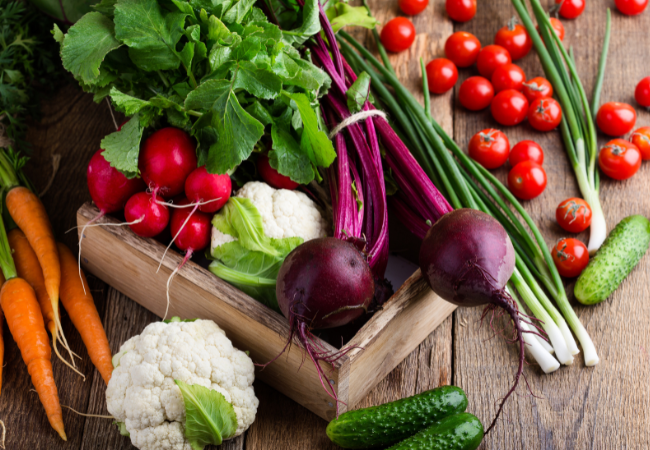
If your farmers market basket is filled first with vegetables—armfuls of greens, a few onions, maybe winter squash or ripe tomatoes—before you think about what else might go with them, you’re already practicing a way of eating that’s gaining quiet momentum.
More and more people are stepping away from rigid food labels and embracing a flexible, plant-centered approach to meals. You may hear it described as plant forward, but the idea itself is refreshingly simple: start with plants, and let everything else play a supporting role.
For many farmers market shoppers, this isn’t a trend — it’s just how cooking naturally unfolds.
Beyond Labels, Toward Balance
This week, I came across a term gaining traction in the food world: flexitarian. While the name may be new, the philosophy is not. For decades, many integrative physicians I respect — Dr. Andrew Weil among them — have advocated for this kind of balanced, plant-centered approach as the most sensible path to long-term health. (For a food pyramid grounded in medical training and nutritional science, Dr. Weil’s infographic for an anti-inflammatory diet* is a helpful reference.)
By contrast, the official food pyramids and dietary frameworks periodically released by government administrations are often shaped as much by policy, economics, and industry influence as by medicine or nutrition education. They can be useful in broad strokes, but they rarely reflect how physicians who study diet and health actually advise their patients to eat.
Terms like vegetarian and vegan certainly have their place, but for many people they feel restrictive — an all-or-nothing proposition. Not everyone wants rigid rules around food, especially when eating is meant to be both nourishing and enjoyable.
A flexible, plant-centered mindset removes that pressure. It doesn’t ask you to give anything up. Instead, it gently shifts the focus toward vegetables, fruits, grains, beans, and herbs—while leaving room for eggs, dairy, seafood, or meat when they make sense.
It’s less about identity, and more about intention.
Why Farmers Markets Make This Way of Eating Easy
Farmers markets naturally encourage a plant-centered rhythm. What’s fresh and abundant sets the tone for the week’s meals. A pile of broccoli suggests a stir-fry. Tender greens become the base for pasta, soup, or grain bowls. Heirloom tomatoes practically demand to be eaten simply, with good olive oil and salt.
Protein often becomes an accent rather than the centerpiece:
- A handful of beans stirred into a vegetable soup
- A soft-boiled egg on roasted greens
- A little cheese crumbled over a salad
- A portion of fish alongside a plateful of vegetables
Meals feel generous, colorful, and satisfying—without needing to be defined by what’s missing.
Where Protein Fits into the Picture
Much of today’s nutrition conversation — especially around weight loss and athletic performance — places heavy emphasis on protein, often equating “more” with “better.” For certain people and life stages, that emphasis makes sense. Growing children, expectant mothers, and high-performance athletes have increased protein needs, and animal proteins can play an important role in meeting them.
For most adults, however, daily life looks quite different. The average person is not training intensely, building muscle at scale, or recovering from high physical demand—and doesn’t necessarily require large portions of meat at every meal.
A plant-centered approach doesn’t avoid protein; it simply puts it in perspective. Beans, lentils, whole grains, nuts, seeds, dairy, and eggs all contribute meaningful protein, often alongside fiber, minerals, and phytonutrients that are largely absent from meat-heavy diets. While building fully balanced meals from plant sources does take some thought, it’s often easier—and more enjoyable—when vegetables form the foundation and protein becomes a complement rather than the centerpiece.
In this way, meat and seafood retain their value, without crowding out the plants that support overall health. It’s not about eliminating animal foods—it’s about letting vegetables lead, and allowing protein to support the meal, not dominate it.
For many households, this approach feels less like a diet and more like a return to common sense—meals built around vegetables, supported by protein, and shaped by season, appetite, and lifestyle.
Flavor First, Always
One of the great misconceptions about eating more plants is that it means sacrificing flavor. In reality, the opposite is often true.
Vegetables cooked at their peak, seasoned simply, and paired thoughtfully with herbs, citrus, garlic, and good fats are deeply satisfying. When meat or fish appears occasionally rather than daily, it tends to be chosen more carefully—and enjoyed more fully.
This approach invites creativity and keeps meals interesting, especially as the seasons change.
A Practical Way to Shop and Cook at the Farmers Market
If you’re curious to lean a little more plant-forward, the farmers market is the perfect place to begin:
- Shop plants first. Let vegetables guide your meal planning.
- Choose one anchor vegetable for the week and build multiple meals around it.
- Think of protein as a complement, not a requirement.
- Cook once, eat flexibly. A big batch of roasted vegetables can become pasta, salad, soup, or a side dish over several days.
No rules. No labels. Just good food and good ingredients.
Eating Well, One Market Visit at a Time
A flexible, plant-centered way of eating isn’t about perfection or ideology. It’s about paying attention—choosing foods that taste good, feel good, and support the people who grow them.
If your meals already begin with what’s in season and leave room for choice, you’re right where you need to be. Sometimes the smartest shifts don’t need a name at all.
* Many physicians now frame balanced, plant-centered eating through the lens of inflammation—not because inflammation is inherently bad, but because chronic, low-grade inflammation is linked to many of the diseases that become more common with age. Diets rich in vegetables, whole foods, and healthy fats have been shown to help moderate that inflammatory burden.