
Winter and early spring are peak citrus season in California, and there is no better place to experience the full range of what’s grown here than at the farmers market. Citrus is one of the state’s great agricultural success stories, with hundreds of varieties grown up and down the coast and through the Central Valley—each shaped by microclimate, soil, and tradition.
Like most things in food culture, citrus varieties have their moments in the spotlight. Some rise to fame, then quietly fade as new favorites appear. Remember Minneola tangerines and Temple oranges? These days, Cuties dominate lunchboxes—though they are actually a brand name for two mandarins, the Clementine and the Murcott.
Yet some citrus never really goes out of style. Blood oranges are one of those enduring standouts.
What Makes a Blood Orange Special
Blood oranges are the most widely grown orange in Italy, where they are deeply woven into both everyday cooking and celebratory drinks. Here in California, they have become quietly fashionable among cooks, bartenders, and citrus lovers drawn to their complexity, vivid color, and versatility. They offer a flavorful alternative to standard orange juice and have become a favorite in the ongoing cocktail revival.
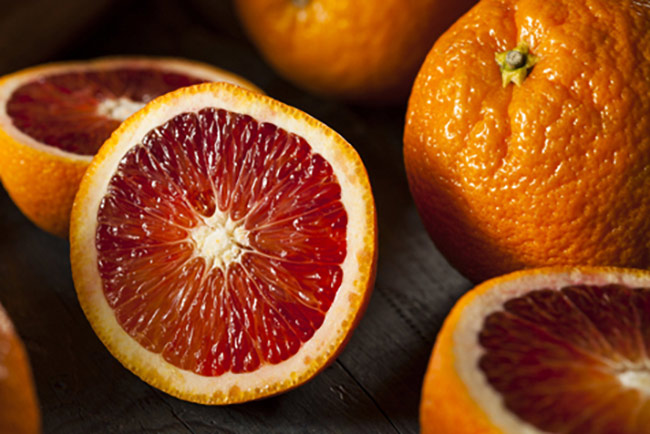
The dramatic red and ruby tones that give blood oranges their name come from anthocyanins—natural pigments that develop only when cool nighttime temperatures meet sunny days. This is why blood oranges thrive in Mediterranean climates like coastal California and Italy, and why they are strictly seasonal.
On the Central Coast, you will most often see three classic varieties at the farmers market: Sanguinello, Tarocco, and Moro.
Meet the Varieties
Sanguinello
Originally from Italy, Sanguinello blood oranges are medium sized with few seeds. From the outside, they most closely resemble a “regular” orange, with a slightly reddish cast to the peel. The skin is fairly thick, similar to a navel or tangerine. Inside, the segments are Valencia-like in texture, with flesh that ranges from orange-red to deep ruby. The flavor is bright and often very sweet, with gentle floral notes.
Tarocco
Tarocco oranges are thinner skinned and visually striking, with peels that can be dark orange streaked with garnet, or washed with broad areas of blush. Inside, the flesh may be dark orange with flecks of red, or boldly striped with deeper hues. Their flavor is consistently excellent throughout the season—rich orange notes balanced by bright acidity and sweetness, often with a hint of strawberry. Medium sized and slightly oval, Taroccos peel easily and are prized for juicing. In Italy, they are the favored orange and the country’s most important citrus crop, widely used in juices and sodas.
Moro
The most dramatic of the blood oranges, Moros are small to medium in size with thin skin that can be challenging to peel. The flesh color is spectacular, ranging from deep crimson to burgundy and occasionally nearly black. Timing matters with Moros: harvested too early, they can be sharply tart; too late, they develop muddy or metallic notes. At their peak—right around now—they are extraordinary, with a deep, wine-like orange flavor and hints of raspberry, balanced by bright acidity. Their juice is as visually striking as it is flavorful.
A Note on Cara Cara Oranges
While not a blood orange, Cara Cara oranges often appear alongside them at market. They are a cross between a Brazilian Bahia navel and a Washington navel orange, discovered in Venezuela in 1976 and introduced to the U.S. in 1980. Seedless and low acid, Cara Caras have pinkish flesh and a tangy, refreshing zing that makes them a favorite for eating out of hand.
Cooking with Red-Fleshed Oranges
Blood oranges are endlessly fun in the kitchen and surprisingly versatile. Beyond fruit salads and cocktails, they pair beautifully with savory foods. Try them with roasted cauliflower or broccoli, folded into whole-grain salads, or served alongside light meats and seafood.
One classic preparation is Sauce Maltaise—a variation on hollandaise made with blood orange zest and juice. The result is a vibrant, citrus-forward sauce that is exceptional with fish and makes a memorable twist on a benedict, especially with shrimp and avocado.
Good for You, Too
Blood oranges are as nutritious as they are beautiful. One medium fruit provides approximately 130 percent of the recommended daily value of vitamin C, along with folate, thiamin, calcium, and about 7 grams of dietary fiber. Their anthocyanins are powerful antioxidants—up to three times higher than in regular oranges—adding another reason to enjoy them while they are in season.
How to Choose and Use Blood Oranges
When selecting blood oranges, look for fruit that feels heavy and dense for its size. The skin should be firm but not hard, with no soft or spongy spots. Avoid wrinkled skins or any hint of moldy aroma.
If the oranges are unwaxed and untreated, the peel is valuable: remove the pith and use the zest in drinks, sauces, or candies. The peel can also be dried and ground into a fragrant citrus spice.
Find Them at the Market
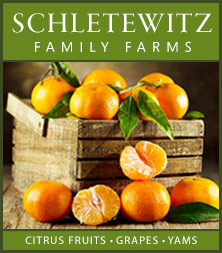
Look for fresh, California-grown blood oranges from Rancho Padre, Brokaw Ranch Company, and Schletewitz Family Farms at our farmers markets. Peak season is short, so enjoy these stunning citrus fruits while they are at their very best.
Find RECIPES HERE.