
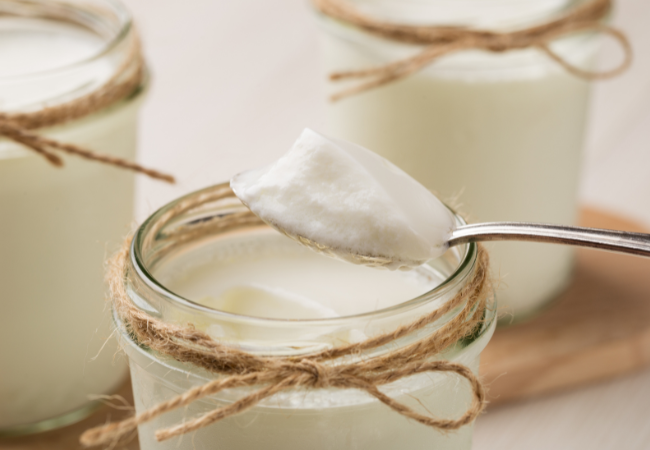
There’s something deeply satisfying about making yogurt from scratch — transforming a simple gallon of milk into something rich, nourishing, and quietly luxurious. Once you understand the rhythm of the process, it becomes less of a recipe and more of a kitchen ritual.
This formulation is designed to create a creamy, balanced yogurt with a mild tang and a smooth, spoonable texture — similar to a classic European-style whole milk yogurt. Using a sous vide circulator takes the guesswork out of temperature control, making the process remarkably consistent and approachable.
It’s also a perfect moment to begin. As fresh fruit comes into season at the farmers market, homemade yogurt becomes a beautiful canvas — ready to be paired with berries, stone fruit, or a drizzle of local honey.
INGREDIENTS:
1 gallon whole organic milk (avoid ultra-pasteurized/UHT if possible)
1/4 cup dry milk powder (whole milk, not non-fat)
2 tablespoons Kate’s Naturals inulin (powder — strongly recommend)
1/4 cup Nancy’s plain whole milk yogurt (or other plain yogurt with live active cultures and no additives)
EQUIPMENT
Tall, narrow, heat-safe vessel (stainless steel or thick glass)
Sous vide circulator (Anova Precision Pro is perfect here)
Thermometer (optional)
4 quart-size wide-mouth jars and lids
STERILIZE JARS
- Place jars and lids in boiling water for 10 minutes or run through a hot dishwasher cycle
- Allow to air dry before use
HEAT TREAT THE MILK (PROTEIN DENATURING)
- Place milk in large stainless or glass container that fits inside sous vide container
- Fill sous vide container part way with warm water. Affix circulator
- Place container with milk into water bath. Fill until water level is equal to or slightly higher than milk level
- Set circulator to 185°F
- When milk reaches temperature, hold for 45 minutes
The milk may develop a light skin and a slightly “cooked” aroma — this is normal.
COOL TO INOCULATION TEMPERATURE
- Reduce bath temperature to 110°F
- Leave vessel in bath until milk cools to 110°F
- Remove milk skin from surface with a slotted spoon
INOCULATE THE FULL BATCH
- Ensure milk is at or below 110°F before adding starter
- In a small bowl, combine dry milk powder and inulin with 1 cup warm milk
- Whisk until smooth
- Add 1/4 cup yogurt starter and whisk until fully combined
- Pour mixture through a fine-mesh strainer to remove any lumps
- Gently whisk mixture back into the full batch
PORTION INTO JARS
- Pour inoculated milk into sterilized quart jars, leaving 3/4 to 1 inch headspace
- Loosely cap with lids (do not tighten)
INCUBATE
- Place jars in water bath
- Add water until level is equal to or slightly above milk line in jars
- Set sous vide circulator to 110°F
- Incubate for 10 hours
- Avoid moving or disturbing jars during incubation
- Check water level occasionally and add warm water if needed
CHILL TO SET
- Remove jars gently from water bath
- Transfer directly to refrigerator without disturbing
- Chill 8–12 hours, undisturbed
The final chill is where the yogurt fully sets and firms.
Texture Expectations (1-Gallon Batch)
- Fully set, spoonable yogurt
- Clean lactic aroma
- Minimal whey separation
- Flavor and body similar to Nancy’s Whole Milk Plain Yogurt
If you see a little whey on top — that’s authentic.
Best Practices for Quart Jars
- Wide-mouth jars are easiest for pouring and serving
- Leave 3/4–1 inch headspace
- Cap loosely (fingertip-tight)
- Do not move jars during incubation
- Chill undisturbed for at least 8 hours
Why I Use Inulin
- Soluble prebiotic fiber
- Mild natural sweetness
- Improves mouthfeel and creaminess
- Supports beneficial gut bacteria
Notes on Incubation Time
This formulation is designed to mirror the balanced tang and texture of Nancy’s yogurt.
- For slightly milder flavor: incubate 9 hours
- For fuller tang and body: incubate 10 hours
The addition of inulin may slightly soften perceived tang, which is why a slightly longer incubation works well here.
Storage
- Refrigerate for up to 10–14 days
- Reserve a few tablespoons from each batch to use as starter for the next
There’s something quietly rewarding about this process — simple ingredients, a bit of patience, and a result that feels both nourishing and deeply homemade. Once you begin, it’s hard to go back.