
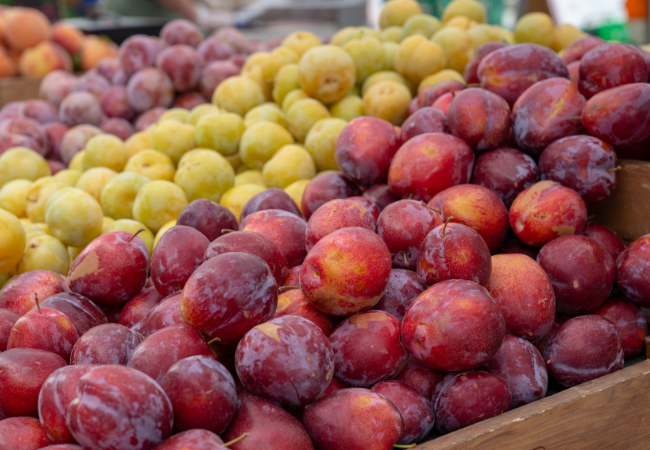
Just when you think summer stone fruit season is winding down, some of the most distinctive plums of the year begin arriving at the farmers market.
Late summer and early fall bring a changing cast of varieties—some deep purple and richly sweet, others ruby-red inside, and still others green-gold even when perfectly ripe. It’s a reminder that “plum” describes an astonishingly diverse family of fruit, each with its own flavor, texture, color, and best use in the kitchen.
Right now, look for Betty Ann, Catalina, Elephant Heart, Emerald Beauty, Hiromi Red, and Italian Prune plums at the markets from Minazzoli Farms, Stackhouse Orchards, Kashiwase Farm, and Rancho Padre.
A Plum for Every Taste
If you tend to buy the same familiar plum each year, this is a particularly good time to branch out.
Catalina is a beautiful dark-skinned plum with sweet, juicy flesh and very little tartness—a particularly good choice for eating out of hand.
Then there is the remarkable Elephant Heart, a treasured old variety developed by famed California horticulturist Luther Burbank. Beneath its mottled reddish-purple skin is striking deep-red flesh with a rich, complex flavor. When perfectly ripe, it is exceptionally juicy and one of those fruits that makes a strong case for shopping at a farmers market, where unusual varieties can still find a home.
Emerald Beauty may be the plum most likely to fool you. Unlike varieties that deepen dramatically in color as they ripen, Emerald Beauty stays green to greenish-yellow. Let it ripen and it becomes remarkably sweet while retaining a pleasantly firm texture.
Hiromi Red offers another contrast, with attractive red-over-yellow skin and firm yellow flesh. It is sweet and mild with a pleasing balance of sugar and acidity.
And then there are Italian Prune plums, the elongated blue-purple plums that arrive as summer begins giving way to fall. Sweet enough for fresh eating, they are also wonderful for baking, roasting, preserves, compotes, and—of course—drying.
Don’t Judge a Plum by Its Color
One of the pleasures of buying plums directly from a farmer is being able to ask, Which one is ready to eat today?
Plums can be surprisingly difficult to judge by appearance alone. Some varieties soften noticeably as they ripen; others remain fairly firm. Some deepen in color, while a variety such as Emerald Beauty stays decidedly green.
Ask the farmer what they recommend and when the fruit will be at its best. If a plum needs another day or two, leave it at room temperature and check it daily.
And if you see a variety you’ve never tried before, buy a few.
The succession of varieties is part of what makes shopping the farmers market so much fun. The peaches and nectarines may be beginning to fade, but stone fruit season still has a few wonderful surprises left.
What to Make with Late-Summer Plums
Late-season plums are wonderfully versatile in the kitchen. Their sweet-tart flavor works just as well in savory dishes as it does in desserts, and different varieties lend themselves to different preparations.
For something unexpected, try Plum Mostarda, a sweet, tangy condiment that is especially good with cheese, charcuterie, roast pork, or chicken.
If you want something simple, Honey-Roasted Plums with Thyme may be the easiest place to start. Serve them warm with yogurt, mascarpone, vanilla ice cream, or alongside a savory main dish.
For baking, Old-Fashioned German Plum Kuchen is a natural choice for Italian prune plums and makes an easy everyday cake for brunch, dessert, or afternoon coffee.
And when you want something a little more elegant, Plum Frangipane Tart pairs ripe plums with rich almond filling in a buttery tart shell.
However you use them, this is the moment to enjoy late-summer plums while they are at their peak.