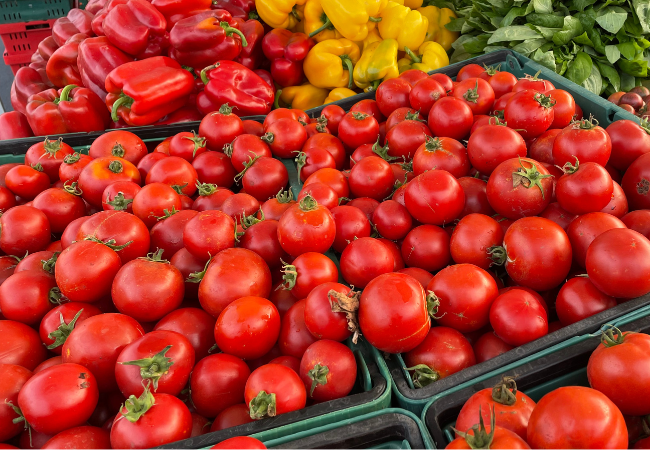

There’s something deeply satisfying about putting away a few jars of tomato sauce while ripe tomatoes are still at the farmers market. Months later, those jars become the beginning of a comforting soup, a bubbling pan of lasagna, or a simple pasta supper.
Plain tomato sauce is especially useful because you can season it to suit the meal when you open the jar.
This guide follows the National Center for Home Food Preservation’s research-tested Standard Tomato Sauce procedure, using a boiling-water canner. Follow the ingredients, preparation, acidification, headspace, and processing times as directed.
Start with Sound Tomatoes
Choose firm, disease-free tomatoes, preferably ripened on the vine. Do not can tomatoes from dead or frost-killed vines. Discard moldy or decaying fruit.
Ingredients and Yield
For approximately 9 pint jars, start with:
- 21 pounds tomatoes for thin sauce, or
- 28 pounds tomatoes for thick sauce
- Bottled lemon juice from concentrate, or food-grade citric acid, measured into each jar as directed below
- Canning or pickling salt, optional: ½ teaspoon per pint or 1 teaspoon per quart
Yield varies with the tomatoes and reduction. Keep this preparation plain: add garlic, onions, oil, vegetables, and other flavorings when you open the sauce for cooking. These processing instructions apply to the tested plain sauce.
Equipment
Have ready a boiling-water canner with a rack, pint or quart home-canning jars, new flat lids and compatible screw bands, a jar lifter, canning funnel, headspace tool, and a food mill or fine sieve.
Inspect jars for cracks and chipped rims. Wash thoroughly and keep hot until filling. Prepare lids according to their manufacturer’s instructions. Empty jars do not require separate sterilization for this recipe because the processing time exceeds 10 minutes.
Add Acid to Every Jar
Acidification is required. Choose one of the following options for each jar:
|
Jar size |
Bottled lemon juice from concentrate |
Food-grade citric acid |
|
Pint |
1 tablespoon |
¼ teaspoon |
|
Quart |
2 tablespoons |
½ teaspoon |
Add the measured acid directly to each hot jar before filling. Salt is optional; acid is not.
For lemon juice, check the label for “from concentrate” or “reconstituted.” Do not substitute freshly squeezed juice or bottled juice labeled “not from concentrate.”
Method
1. Prepare the canner
Place the rack in the canner and add water. Preheat to approximately 180°F for this hot-pack recipe. Allow enough room to cover the filled jars with 2 inches of water once loaded.
2. Heat the tomatoes
Wash tomatoes, remove stems, and trim away bruised or discolored portions.
To help prevent separation, quickly quarter about 1 pound and place in a large saucepan. Bring immediately to a boil while crushing. Gradually add the remaining freshly quartered tomatoes, crushing and maintaining a vigorous boil as you work.
Once all tomatoes have been added, simmer for 5 minutes.
3. Remove skins and seeds
Pass the hot tomatoes through a food mill or fine sieve to remove skins and seeds. Return the strained tomato mixture to a wide saucepan.
4. Reduce the sauce
Simmer until the volume is reduced by approximately:
- One-third for thin sauce
- One-half for thick sauce
Stir frequently as it thickens. Do not reduce this sauce to tomato paste.
5. Fill the jars
Add the required acid and optional salt to each hot jar. Ladle in the hot sauce, leaving ¼ inch of headspace between the sauce and the jar rim.
Remove trapped air bubbles with a suitable nonmetallic tool and recheck the headspace. Wipe rims clean, apply lids, and tighten bands according to the lid manufacturer’s directions.
6. Process in boiling water
Lower jars upright onto the canner rack. Ensure water covers the lids by 2 inches. Cover the canner and bring to a full boil.
Begin timing only when the water returns to a full boil. Maintain a continuous boil throughout processing. If boiling stops, bring it back to a boil and restart the entire processing time.
Use the time for your jar size and the elevation where you are canning:
|
Elevation |
Pint jars |
Quart jars |
|
0–1,000 feet |
35 minutes |
40 minutes |
|
1,001–3,000 feet |
40 minutes |
45 minutes |
|
3,001–6,000 feet |
45 minutes |
50 minutes |
|
Above 6,000 feet |
50 minutes |
55 minutes |
These times apply to hot-packed plain tomato sauce in a boiling-water canner.
7. Remove and cool
When processing is complete, turn off the heat, remove the canner lid, and wait 5 minutes. Lift jars out upright and place on a towel or rack, leaving at least 1 inch between them.
Let cool undisturbed for 12–24 hours. Do not retighten bands or press down on lids during cooling.
After cooling, remove bands and check seals. A sealed lid should curve slightly inward and should not flex up and down when pressed. If a jar has failed to seal and you discover it within 24 hours, refrigerate promptly and use within several days.
Store Your Sauce
Wash and dry sealed jars, label with the contents and date, and store without screw bands in a cool, dark, dry place. For best quality, use within one year.
Before opening, check for broken seals, leakage, bulging lids, or other signs of spoilage. Never taste suspect sauce to determine whether it is safe.
Make It Your Own When You Open It
For a quick dinner, sauté garlic in olive oil, add a jar of sauce, and finish with basil. Use it in vegetable soup, simmer it with white beans, or build a richer sauce with mushrooms and herbs.
A plain jar of tomatoes leaves plenty of possibilities for the cook—and brings a welcome reminder of market season to the winter kitchen.
SOURCE: National Center for Home Food Preservation: Standard Tomato Sauce, with accompanying acidification and boiling-water canning guidance.