
Few fruits deliver as much aroma and flavor in such a small package as passionfruit.
Beneath its sometimes wrinkled purple or golden skin is a fragrant, jewel-like pulp filled with crunchy edible seeds. The flavor is unmistakably tropical—bright, tart, floral, citrusy, and sweet all at once. Even a spoonful can transform a bowl of yogurt, a dessert, a cocktail, or a simple fruit salad.
If you spot passionfruit at the farmers market, don’t be put off by fruit that looks a little wrinkled. In fact, that may be exactly what you want.
What Is Passionfruit?
Passionfruit grows on vigorous flowering vines in the genus Passiflora. The fruit is native to South America but is now cultivated in warm climates around the world, including right here on the Central Coast. In fact, many local fences and garden walls are covered with passionflower vines. You may recognize the plant by its extraordinary, almost alien-looking flowers, even if you have never noticed the fruit that follows. Once you know what to look for, you may be surprised by just how much passionfruit is growing in our own neighborhoods.
The two most familiar types are purple passionfruit, which tends to be relatively small and intensely flavored, and yellow passionfruit, which is generally larger and can be more tart.
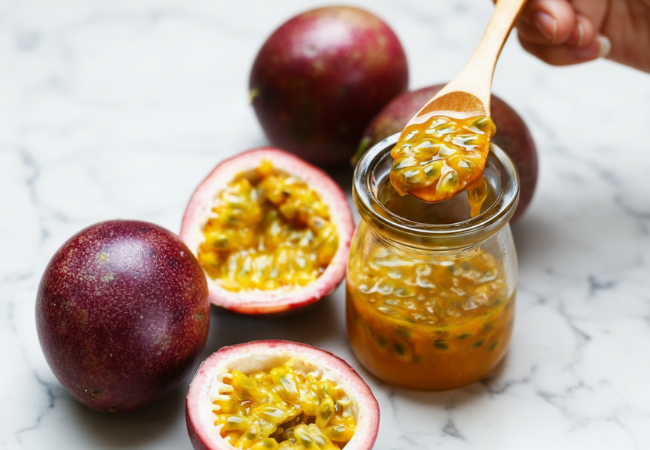
Inside, both contain a soft, juicy pulp surrounding numerous black seeds. The seeds are completely edible and add a pleasant crunch.
Despite its exotic appearance, passionfruit is wonderfully easy to eat: simply cut it in half and scoop out the pulp with a spoon.
How to Choose Passionfruit
Unlike many fruits, perfectly smooth passionfruit isn’t necessarily the prize.
Look for fruit that feels heavy for its size, an indication that it contains plenty of juicy pulp. The skin should be deeply colored without large soft or moldy areas.
A smooth passionfruit is usually less ripe and may be quite tart. As it ripens, the skin begins to wrinkle and the flavor becomes sweeter and more aromatic.
A somewhat shriveled passionfruit may look past its prime, but it can actually be at its most flavorful.
If the fruit is very lightweight, extremely hard, or dried and hollow feeling, however, it may have lost too much moisture.
How to Ripen and Store It
If your passionfruit is still smooth and firm, leave it at room temperature for a few days. Once the skin begins to wrinkle and the fruit becomes fragrant, it is ready to enjoy.
Ripe passionfruit can be refrigerated to extend its life.
The pulp also freezes beautifully. Scoop it into a freezer-safe container or freeze small portions for later use in sauces, desserts, drinks, and breakfast dishes.
Because the flavor is so concentrated, even a small amount can go a long way.
Don’t Strain Out Those Seeds—Unless You Want To
One of the pleasures of fresh passionfruit is the contrast between its silky pulp and crunchy seeds.
For spooning over yogurt, ice cream, cheesecake, panna cotta, or fruit, there is no need to strain it at all.
For very smooth preparations such as curds, sauces, sorbets, cocktails, or pastry fillings, the pulp can be pressed through a fine sieve to remove some or all of the seeds.
Another option is to strain most of the pulp and stir a spoonful of seeds back in for texture and visual appeal.
Easy Ways to Use Fresh Passionfruit
Perhaps the easiest way to enjoy passionfruit is straight from the shell with a spoon. But its tartness makes it especially good when paired with creamy, sweet, or rich foods.
- Spoon fresh passionfruit over Greek yogurt with honey or granola.
- Add it to chia pudding, oatmeal, overnight oats, or a smoothie bowl.
- Spoon it over vanilla ice cream, coconut ice cream, panna cotta, cheesecake, pavlova, or pound cake.
- Fold the pulp into whipped cream or mascarpone for a quick dessert topping.
- Stir it into fruit salads, especially those containing mango, pineapple, berries, peaches, nectarines, or citrus.
- Mix it into sparkling water, lemonade, iced tea, or tropical fruit drinks.
- Add it to cocktails or alcohol-free spritzers with lime, mint, ginger, or sparkling water.
- Its acidity also works surprisingly well in savory dishes.
Passionfruit can be whisked into vinaigrettes, combined with citrus for seafood sauces, or used in glazes for chicken, pork, or grilled vegetables. It is especially good with avocado, cucumber, chile, ginger, cilantro, coconut, and lime.
Make a Simple Passionfruit Sauce
One of the easiest ways to turn a handful of passionfruit into something special is to make a quick sauce.
Combine fresh passionfruit pulp with a little sugar or honey and warm it gently just until the sweetener dissolves. Add a squeeze of lemon or lime if desired.
Cool the sauce and spoon it over yogurt, pancakes, waffles, ice cream, cheesecake, pound cake, or fresh fruit.
For a richer dessert sauce, whisk passionfruit pulp into a simple fruit curd or fold it into lightly sweetened whipped cream.
Passionfruit Curd
If you love lemon curd, passionfruit curd may become a new favorite.
The fruit’s natural tartness is ideal for a silky curd made with eggs, sugar, butter, and passionfruit juice or pulp. Spread it on toast or scones, spoon it into tart shells, layer it into parfaits, or use it as a filling for cakes.
Passionfruit curd also pairs beautifully with coconut desserts.
Passionfruit and Chocolate
Chocolate and passionfruit may not seem like an obvious combination, but pastry chefs have long known how well they work together.
The sharp tropical acidity of passionfruit cuts through the richness of chocolate, particularly dark chocolate and white chocolate.
Try passionfruit with chocolate mousse, brownies, chocolate tart, chocolate cake, or chocolate ganache.
White chocolate and passionfruit are especially complementary—the sweetness of the chocolate softens the fruit’s tartness while allowing its perfume to shine.
Passionfruit in Salad Dressings
For an easy vinaigrette, whisk passionfruit pulp with olive oil, a little honey, lime juice, salt, and freshly ground pepper.
It is lovely on salads containing avocado, cucumber, tender greens, citrus, mango, toasted nuts, or mild fresh cheeses.
A small amount of minced chile or fresh ginger can take the dressing in a completely different direction.
A Little Fruit With a Lot of Personality
Passionfruit may be small, but there is nothing subtle about it.
Its intense fragrance and sweet-tart flavor make it one of the easiest ways to bring tropical character to both everyday dishes and special desserts.
And remember: when shopping for passionfruit, wrinkles are not necessarily a warning sign.
They may be telling you that something delicious is waiting inside.
RECIPES: Passionfruit