
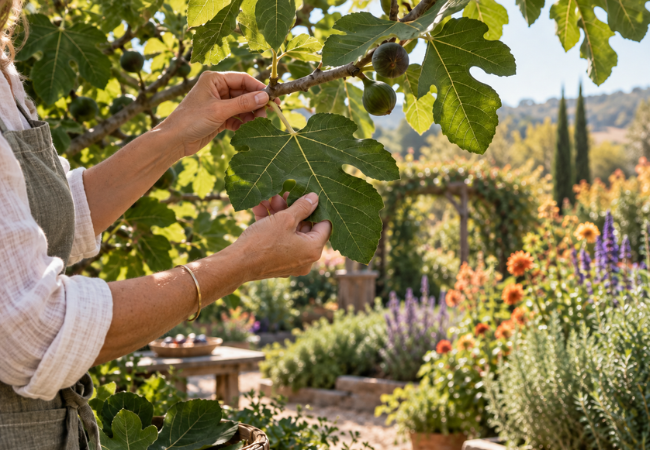
Before the figs are ripe, the leaves may be hiding one of the most delicious flavors of the season.
If you have a fig tree growing in your yard, chances are you spend most of the year waiting for the fruit.
But perhaps we’ve been overlooking half the harvest.
Those beautiful, deeply lobed fig leaves are remarkably fragrant and can be used to make an aromatic syrup with flavors that are often described as coconut, vanilla, toasted nuts, and fresh green herbs. It’s a little unexpected—the flavor tastes far more tropical than you might imagine from a leaf plucked from a backyard tree.
Fig leaves have long been used in cooking to perfume foods, infuse liquids, and even wrap foods during cooking. When steeped in a simple sugar syrup, their fragrance becomes particularly noticeable: soft, warm, slightly grassy, and almost reminiscent of coconut and vanilla.
And unlike the fleeting fig harvest, leaves are generally abundant throughout the growing season.
That makes fig leaf syrup one of our favorite kinds of kitchen projects: something delicious made from an ingredient most of us never realized we could use.
Which Fig Leaves Should You Pick?
Choose healthy, fresh green leaves from a fig tree that has not been sprayed with pesticides or other garden chemicals.
Younger leaves tend to be tender and fragrant, but there’s no need to pick the very newest growth. Look for clean, supple leaves without significant insect damage or discoloration.
Clip the leaves with a short section of stem attached, then remove the stems before using.
Fig trees release a milky latex-like sap when leaves or stems are cut. The sap can irritate sensitive skin, so avoid getting it on your hands and wash the leaves thoroughly before bringing them into the kitchen. Wearing garden gloves while harvesting is an easy precaution.
And resist the temptation to nibble on the raw leaves—the magic happens when their fragrance is used as an infusion.
Fig Leaf Syrup
This beautifully aromatic simple syrup captures the tropical, vanilla-like fragrance of fresh fig leaves. Use it anywhere you might ordinarily reach for a flavored simple syrup.
INGREDIENTS:
4 to 5 fresh fig leaves, washed well and stems removed
1 cup granulated sugar
1 cup water
Wash the fig leaves thoroughly under cool running water and pat dry. Remove and discard the stems.
Combine the sugar and water in a small saucepan over medium heat. Stir until the sugar has completely dissolved.
Bring the mixture just to a gentle simmer and cook for 3 to 5 minutes. There is no need to boil it vigorously.
Remove the saucepan from the heat and add the fig leaves, gently pressing them beneath the surface of the syrup.
Cover the pan and allow the leaves to steep as the syrup cools to room temperature, about 45 minutes to 1 hour.
Taste the syrup. If you’d like a stronger infusion, allow the leaves to steep a little longer.
Remove the leaves and strain the syrup through a fine-mesh strainer into a clean glass jar or bottle.
Refrigerate until thoroughly chilled.
YIELD: Makes about 1½ cups
STORAGE: Keep fig leaf syrup refrigerated in a clean, tightly covered container. For best flavor and quality, use it within about two weeks. Discard it if you notice fermentation, mold, cloudiness, or an off aroma.
What Does Fig Leaf Syrup Taste Like?
This is part of the fun.
Taste the finished syrup without knowing what went into it and you might guess coconut, vanilla, almond, or even pandan before you guessed fig leaf.
The flavor is fragrant rather than intensely sweet or fruity. There is no pronounced ripe-fig flavor. Instead, it has a tropical, softly nutty quality with a green freshness underneath.
That subtlety makes it surprisingly versatile.
15 Ways to Use Fig Leaf Syrup
Make fig leaf soda: Add a spoonful or two to a glass of sparkling water with plenty of ice and a squeeze of lemon.
Sweeten lemonade: Replace part or all of the sugar syrup in homemade lemonade with fig leaf syrup. Lemon and fig leaf are wonderful together.
Make a botanical limeade: Lime brings out the syrup’s tropical side beautifully.
Add it to iced tea: Try it with black tea, green tea, or lightly brewed jasmine tea.
Make a summer spritzer: Combine fig leaf syrup with sparkling water, fresh citrus, cucumber, or muddled berries for an elegant alcohol-free drink.
Sweeten cold-brew coffee: Fig leaf’s vanilla-coconut character is surprisingly good with coffee. Add a splash of milk or cream if you like.
Flavor an iced latte: Use a teaspoon or two in place of vanilla syrup.
Drizzle it over yogurt: Plain Greek yogurt, fresh figs or berries, toasted nuts, and fig leaf syrup make a very good breakfast.
Spoon it over panna cotta: This may be one of its best uses. The creamy vanilla dessert provides the perfect backdrop for the fragrant syrup.
Serve it with vanilla ice cream: Add sliced fresh figs, peaches, or toasted almonds.
Brush it over cake: Use the syrup as you would a cake soak on vanilla, almond, olive oil, or lemon cake.
Sweeten whipped cream: Add a spoonful to softly whipped cream and serve with summer fruit.
Dress a fruit salad: Toss peaches, nectarines, berries, melon, or pears with just enough syrup to lightly gloss the fruit, then add a squeeze of lemon.
Poach fruit with it: Add a little fig leaf syrup to pears, peaches, or quince toward the end of cooking.
Glaze roasted fruit: Brush halved peaches, apricots, pears, or figs with a little syrup during the last few minutes of roasting.
A Natural Partner for Late Summer Fruit
Fig leaf syrup seems particularly suited to the fruits growing alongside fig trees during the warmer months. Try it with:
- Peaches and nectarines
- Fresh figs
- Strawberries
- Blackberries
- Melon
- Plums
- Pears
- Citrus
A bowl of sliced peaches with fig leaf syrup, lemon juice, and a spoonful of crème fraîche may be all the dessert you need.
Make a Fig Leaf Cream Soda
For perhaps the simplest introduction to fig leaf syrup, fill a tall glass with ice.
Add 1 to 2 tablespoons fig leaf syrup, fill almost to the top with sparkling water, and finish with a splash of milk, half-and-half, or your favorite creamy alternative.
Stir gently.
The combination accentuates the vanilla-coconut character of the leaves and turns an ordinary garden ingredient into something that tastes remarkably luxurious.
Don’t Stop at Syrup
Once you notice the fragrance of fig leaves, you begin seeing possibilities everywhere.
They can be used to infuse cream for custards or ice cream, steeped in milk, used to perfume rice, or wrapped around foods to lend their aroma during cooking. Dried fig leaves can also be used for fragrant infusions.
But syrup may be the easiest place to begin.
So the next time you walk past a fig tree while waiting impatiently for those green figs to ripen, look at the leaves.
The tree may already have given you something worth harvesting.