

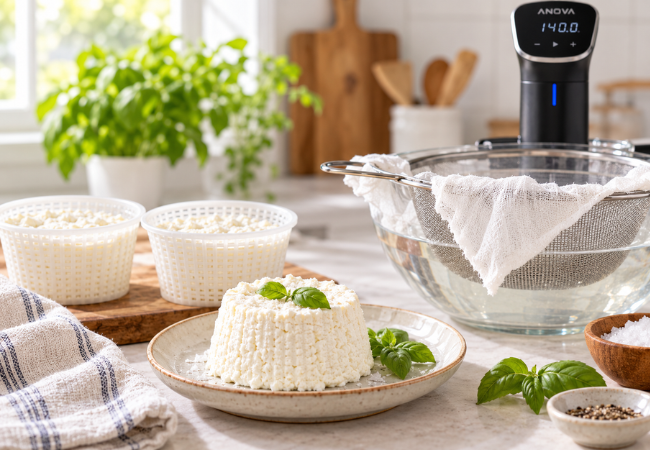
There is something deeply satisfying about making fresh cheese at home, especially when the process is as simple as milk, lemon juice, and a little salt. With an immersion circulator, the milk heats gently in a precisely controlled water bath, making it easier to achieve the delicate curds that give homemade ricotta its soft, creamy texture.
Spoon it warm over pasta, spread it on toasted bread, or use it anywhere you would enjoy fresh, creamy ricotta.
INGREDIENTS:
½ gallon whole milk, preferably not ultra-pasteurized
¼ cup freshly squeezed lemon juice, plus a little more if needed
¼–½ teaspoon fine sea salt, to taste
EQUIPMENT:
Immersion circulator (Anova is my favorite brand)
Large heat-safe container for the water bath
Tall stainless-steel stock pot or other heat-safe vessel that fits comfortably inside the water bath
Fine-mesh strainer
Cheesecloth or ricotta basket
Instant-read thermometer
METHOD:
Prepare the water bath. Set the immersion circulator to 190°F. Use a container large enough to accommodate the stock pot while allowing water to circulate freely around it.
Heat the milk. Pour the milk into the stock pot and place the pot in the water bath. The water should come high enough around the outside of the pot to heat the milk evenly, without any risk of water spilling into the milk. Heat until the milk itself reaches approximately 190°F. Check the milk with an instant-read thermometer rather than relying on the water-bath temperature alone.
Add the acid. Carefully remove the pot from the water bath. Gently stir in the lemon juice and salt. Stir only briefly, then leave the milk undisturbed for 10–15 minutes while the curds form.
Check the curds. The milk should separate into soft white curds and translucent, yellowish whey. If the whey remains very milky and distinct curds have not formed, gently stir in another teaspoon or two of lemon juice and allow it to rest for several more minutes.
Drain. Carefully ladle the curds into a cheesecloth-lined strainer or ricotta basket set over a bowl. Allow to drain for 15–30 minutes for a soft, spoonable cheese, or longer for a firmer texture. Avoid squeezing the curds if you prefer a delicate ricotta.
Serve or chill. Enjoy the ricotta warm, or transfer it to a covered container and refrigerate promptly. For a firmer cheese, chill for about 2 hours before serving.
Storage: Keep refrigerated at 40°F (4°C) or below and use within 3 days.
Kitchen Wisdom: Don’t Throw Away the Whey
After making fresh ricotta, you’ll be left with a generous amount of pale, slightly tangy whey. Although most of the cheese solids have been removed, this flavorful liquid can still be put to good use in the kitchen. Its gentle acidity makes it especially useful in recipes where you might otherwise use buttermilk, water, or another cooking liquid.
- Bake with it. Substitute whey for some or all of the water in bread, pizza dough, biscuits, or savory quick breads. Its mild tang is particularly nice in whole-grain baking. When using it in recipes that rely on baking soda, remember that the acidity of the whey may affect the leavening balance.
- Make pancakes or waffles. Use whey in place of buttermilk or part of the milk in your favorite recipe. It adds a subtle tang and is an excellent way to use a cup or two at a time.
- Cook grains. Replace some of the water used for rice, quinoa, farro, or polenta with whey. The slightly acidic flavor works particularly well in savory preparations. If the whey tastes strongly of lemon, begin by replacing only half the cooking liquid.
- Add it to soups and stews. Use whey as part of the liquid in vegetable soups, bean soups, or other savory dishes where a little acidity would be welcome. Add it gradually and taste as you go.
- Use it in mashed potatoes. Warm a little whey and stir it into mashed potatoes in place of some of the milk or cooking liquid. Add butter or olive oil as usual and adjust the seasoning.
- Make a simple bread dough. Whey can replace water in many basic yeast breads, giving the finished loaf a subtle flavor and making use of a byproduct that might otherwise be discarded.
STORAGE: Refrigerate whey promptly in a clean, covered container and use it within a few days, or freeze it in measured portions for later use. Because this whey contains lemon juice, taste it before adding it to a recipe and avoid using it where a neutral dairy flavor is essential.
YIELD: Approximately 300g, depending on the milk and draining time.
SEE ALSO: To learn more about using the sous vide method, see: Sous Vide Cooking: A Surprisingly Versatile Kitchen Technique