
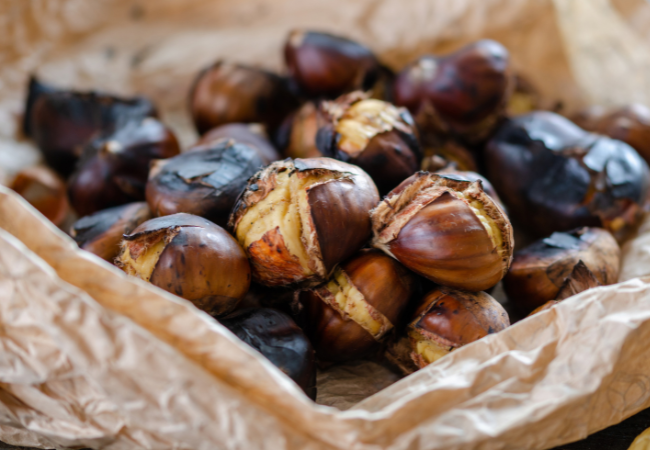
Fresh chestnuts are one of fall’s fleeting pleasures—and they’ve arrived at the farmers market. Find locally grown chestnuts now at Minazzoli Farms, but don’t wait too long. Their season is short!
There is something wonderfully old-fashioned about a basket of glossy brown chestnuts. Long before they became immortalized in holiday songs, chestnuts were an important food crop, feeding families across Europe, Asia, and North America for centuries.
Here in the United States, the chestnut also has a remarkable—and bittersweet—story.
The Tree That Once Defined the Eastern Forest
The American chestnut, Castanea dentata, was once one of the dominant trees of eastern North America, growing from Maine south through the Appalachian Mountains and into the Southeast. Enormous trees towered over forests and provided abundant nuts for people, livestock, and wildlife.
Chestnut wood was equally prized. Straight-grained, lightweight, easy to work, and naturally resistant to decay because of its tannin content, it was used for everything from barns and furniture to railroad ties, telephone poles, and fence posts.
Then came chestnut blight.
First identified in New York in 1904, the fungal disease had been introduced to North America on imported Asian chestnut trees. It spread astonishingly quickly. Within decades, an estimated four billion American chestnut trees had been killed, effectively removing one of the great trees of the eastern forest.
The story isn’t quite over, however. Researchers, conservationists, and breeders continue working to develop disease-resistant American chestnuts and restore the tree to portions of its historic range.
A Different Kind of Nut
Chestnuts are quite unlike walnuts, almonds, pecans, or hazelnuts.
Rather than being rich and oily, chestnuts are starchy, mildly sweet, and relatively low in fat. Their texture when cooked is somewhere between a potato and a firm sweet potato, with a delicate, almost vanilla-like nuttiness.
They are also notable among nuts for containing vitamin C and are a source of dietary fiber. Chestnuts can be dried and ground into a naturally gluten-free flour, a traditional ingredient in parts of Italy and France.
Their high starch content explains why chestnuts have historically been such an important staple food. In regions where grain was difficult to grow, chestnut trees provided a dependable source of carbohydrates that could be roasted, boiled, dried, ground into flour, or preserved for winter.
There is even an old nickname for them: “the grain that grows on trees.”
What Do Fresh Chestnuts Taste Like?
If your only experience with chestnuts comes from a holiday song, you’re in for a treat.
Freshly roasted chestnuts have a tender, slightly crumbly texture and a gentle sweetness. Their flavor is earthy and nutty without being heavy, with hints that can seem almost buttery or vanilla-like.
Eat them warm straight from the shell, or use cooked chestnuts in both sweet and savory dishes.
They are especially delicious in:
- Stuffings and dressings
- Autumn soups
- Braised vegetables
- Risotto
- Pasta dishes
- Purées
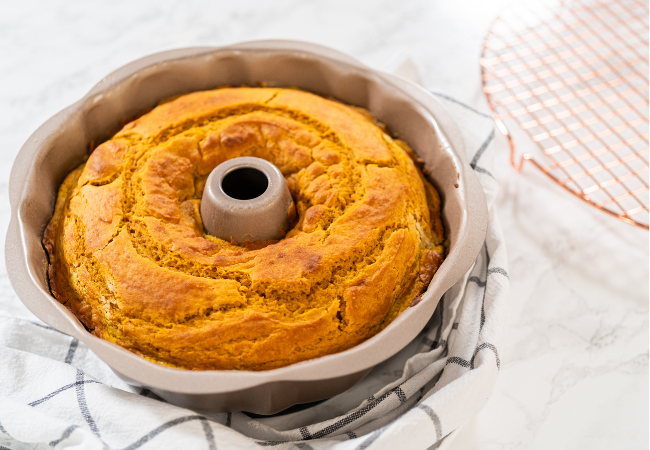
- Cakes and tortes
- Cookies and pastries
- Chocolate desserts
Try chopping roasted chestnuts and scattering them over roasted Brussels sprouts or winter squash, folding them into a wild rice pilaf, or adding them to a pan of roasted mushrooms.
Buying Fresh Chestnuts
Chestnut season is relatively brief, so take advantage of them when you see them at the market.
Look for chestnuts that feel firm, smooth, glossy, and heavy for their size. Avoid nuts with shriveled shells, obvious cracks, or small holes.
If you’re roasting a batch, choose chestnuts of roughly the same size so they’ll cook at about the same rate.
How to Store Them
Don’t treat fresh chestnuts like the bags of dried nuts you keep in the pantry. Because chestnuts contain considerably more moisture and starch than most nuts, they are perishable.
Store fresh, unshelled chestnuts in a closed container or plastic bag in the refrigerator. If you won’t use them soon, they can also be frozen for longer storage.
How to Roast Fresh Chestnuts
Roasting chestnuts takes a little effort, but once you’ve eaten one warm from the oven, you’ll understand why people have been doing it for centuries.
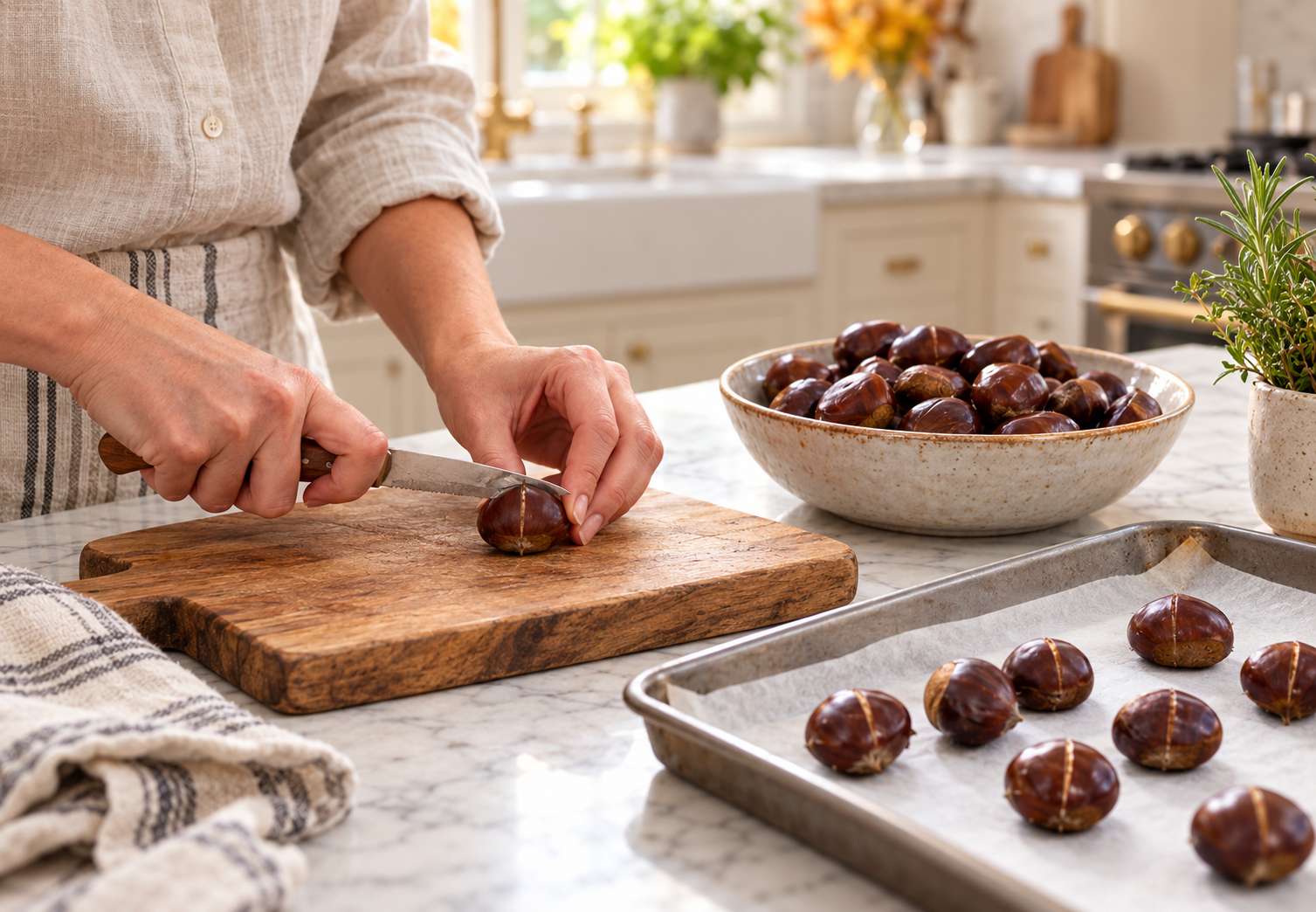
1. Score the chestnuts.
Using a small, sharp knife, carefully cut through the shell and inner skin on the rounded side of each chestnut. An X works well, or make a long slit across the belly of the nut. Scoring is important—it allows steam to escape while the chestnuts roast.
2. Give them a brief soak.
Soak the scored chestnuts in cool water for several minutes, then drain.
3. Roast.
Arrange the chestnuts on a heavy baking sheet and roast in a preheated 400°F oven until the shells begin curling back and the nut inside is tender.
Depending on their size, this can take roughly 15–25 minutes, so begin checking them early.
4. Steam them briefly.
Transfer the hot chestnuts to a bowl and cover them with a clean kitchen towel for several minutes. The trapped steam helps loosen both the hard outer shell and the papery inner skin.
5. Peel while warm.
Chestnuts are much easier to peel while they’re still warm. Work with a few at a time, leaving the rest covered.
If you encounter a stubborn one, return it to the oven for a few minutes and try again.
Then comes the best part: eat a few while they’re still warm.
A Fall Tradition Worth Rediscovering
For generations, chestnuts were everyday food—not a novelty. They were gathered, roasted, boiled, dried, ground into flour, tucked into savory dishes, and transformed into desserts.
Today, encountering locally grown chestnuts at the farmers market feels a little like discovering an old culinary tradition all over again.
Fresh chestnuts are available now from Minazzoli Farms at the farmers markets. Their season doesn’t last long, so pick up a bag while you can, roast a batch, and enjoy one of fall’s oldest—and most delicious—traditions.
Looking for more ideas? Explore our chestnut recipes on Edible Paradise.