
Kitchen Wisdom for holiday baking—and that anxious moment when it’s time to turn out the cake.
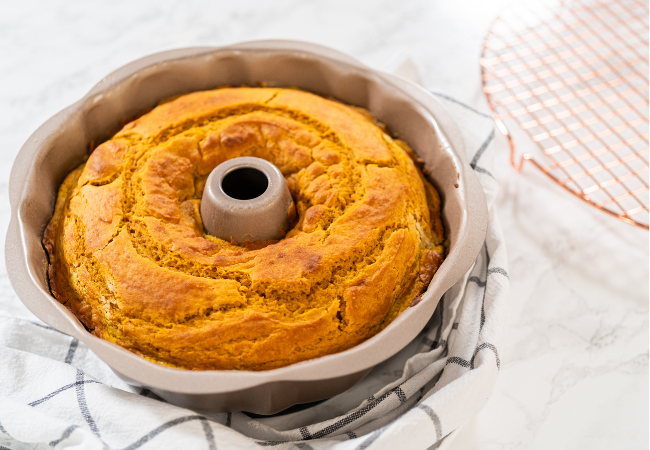
Nothing takes the pleasure out of a baking afternoon quite like turning over a Bundt pan and discovering that the cake has decided to stay put.
I’ve greased and floured. I’ve greased and sugared. I’ve brushed on homemade baker’s “goop,” carefully working it into every little groove. And still, I’ve held my breath while lifting the pan, wondering whether I would find a beautiful cake—or half of one.
In fact, I’ve mostly stopped using my Bundt pan for that very reason. But with Thanksgiving and Christmas approaching, those beloved family recipes start calling: the apple cake, the sour cream pound cake, the holiday cake that simply wouldn’t look quite right baked any other way.
Before we retire our pans altogether, let’s look at what helps—and how to coax out a cake that needs a little persuasion.
Why Bundt Cakes Stick
A Bundt pan’s lovely curves are also its challenge. Every ridge and recess gives batter another place to cling, and parchment can’t come to our rescue as it does in an ordinary cake pan.
Even careful greasing may not overcome old baking spray residue or crumbs tucked into the details. That buildup can become sticky when heated again. Before baking, inspect the grooves and center tube, and clean the pan thoroughly according to the manufacturer’s instructions.
Start with a Carefully Prepared Pan
Check the pan’s interior. A worn or scratched nonstick surface can make releasing a cake more difficult. Whatever preparation method you use, coat every detail, including the center tube, and prepare the pan shortly before filling it so the grease doesn’t have time to slide down and collect in the bottom.
A flour-containing baking spray is one convenient option; Nordic Ware sells and recommends this type of pan release. Follow the instructions for your particular pan.
For those who prefer something homemade, there is also baker’s “goop.”
What About Baker’s Goop?
Despite its rather unglamorous name, cake goop is an established homemade pan release. It combines flour, vegetable oil, and solid vegetable shortening into a spreadable mixture that replaces the separate greasing-and-flouring steps.
King Arthur Baking recommends it as an alternative when parchment isn’t being used, and Joy the Baker uses it for intricately shaped Bundt pans. It is a useful option—although, as some of us have discovered, even goop cannot promise a perfect release every time.
Homemade Baker’s Pan Release
¼ cup all-purpose flour
¼ cup neutral vegetable oil, such as canola
¼ cup solid vegetable shortening, such as Crisco
Stir or beat together until smooth and evenly blended. The proportions are equal by volume, so the batch is easy to increase or decrease.
Using a pastry brush, apply an even coating to the clean, dry pan, reaching into the grooves and around the center tube. Avoid thick deposits that could obscure the pan’s pattern. There is no need for an additional dusting of flour.
Store the remaining mixture in a covered container in the refrigerator. It should remain spreadable when chilled; stir before using if it separates.
Give the Cake a Rest—But Set a Timer
A freshly baked cake needs a little time to firm up before being turned out. Leaving it in the pan too long, however, can make release more difficult.
Follow your recipe’s cooling instructions first. If none are given, about 10 minutes in the pan is a useful starting point for a standard Bundt cake and is Nordic Ware’s general recommendation. Set a timer—especially during holiday baking, when ten minutes can disappear while you’re answering the door or starting another recipe.
When the Cake Refuses to Come Out
Resist the temptation to shake harder. Start by gently loosening the accessible outer edge and the area around the center tube with a thin, flexible tool suitable for your pan. Avoid digging into the decorative contours or scraping a nonstick surface with a sharp knife.
Place a cooling rack over the pan. Using oven mitts, hold the rack and pan securely together and invert them, keeping the rack supported close to the counter. Give the cake a moment to release before lifting the pan.
If it still won’t budge, gentle reheating may help. For an oven-safe metal Bundt pan, King Arthur Baking suggests letting the cake cool on the counter for about 30 minutes, then returning it to a preheated 250°F oven for 3–5 minutes. Using oven mitts, carefully invert it onto the cooling rack again.
This brief warming can help a stubborn cake release, but it is a rescue attempt, not a guarantee. A gentle jiggle is reasonable; vigorous banging is more likely to leave you gathering pieces.
If a Piece Stays Behind
Take a breath before declaring the afternoon a failure. Trust me, I’ve been there too!
Carefully ease out the missing piece and fit it back into place. Once the cake has cooled, a well-placed drizzle of glaze or spoonful of icing can make a small repair much less noticeable.
If the damage is beyond patching, bring out the dessert glasses. Layer pieces of cake with whipped cream and poached pears, spiced apples, or your favorite fruit preserves. There is no shame in serving a lovely holiday trifle.
Of course we want those beautiful curves to emerge intact. We’ve put time, good ingredients, and care into that cake. But whether it reaches the table whole, in slices, or tucked beneath a cloud of whipped cream, it can still be something delicious, made to share.