
And Why a Little Time in the Kitchen Matters…
Changing the way we eat doesn’t have to begin with a complete pantry overhaul.
Sometimes it starts with one small habit.
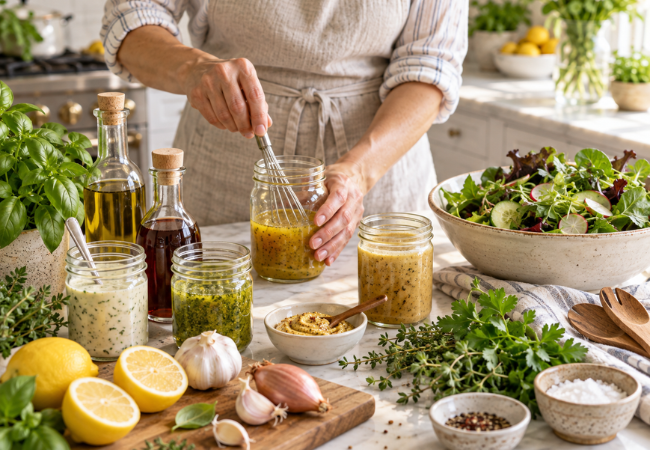
Make your own salad dressing instead of buying a bottle filled with thickeners, stabilizers, flavorings, and preservatives. Stir together a simple vinaigrette with olive oil, vinegar, mustard, and a few herbs. Make a batch of pesto. Cook a pot of soup. Turn ripe fruit into a quick compote or preserve.
These are small things—but they add up.
And once you make something yourself and discover how easy it is, how good it tastes, and how much control you have over the ingredients, it becomes easier to make the next thing.
That is really what cooking from scratch is about.
Not perfection. Not making everything yourself. Not feeling guilty about convenience foods.
It is about building confidence in the kitchen, one recipe at a time.
We talk a lot at Edible Paradise about cooking from scratch. We make yogurt. We whisk our own salad dressings. We turn seasonal fruit into preserves, make crackers instead of buying them, blend herbs into pestos and sauces, and look for ways to transform what we find at the farmers market into food we can enjoy throughout the week—or preserve for the months ahead.
Usually, we do it because homemade simply tastes better.
But there may be another good reason to spend a little more time in the kitchen.
Researchers are paying increasing attention to ultra-processed foods, or UPFs, and the growing role they play in the modern diet. Studies have repeatedly found associations between diets high in ultra-processed foods and poorer health outcomes. A large 2024 review published in The BMJ, encompassing nearly 10 million people across multiple studies, found that greater exposure to ultra-processed foods was associated with a number of adverse health outcomes, particularly cardiometabolic conditions and mortality. The researchers also emphasized that the quality of evidence varied considerably depending on the outcome being studied.
That doesn’t mean every packaged food is something to fear.
It does mean it’s worth understanding what we’re eating.
First, “Processed” Isn’t the Problem
Nearly everything we cook is processed in some way.
Grinding wheat into flour is processing. Freezing blueberries is processing. Turning milk into yogurt or cheese is processing. Canning tomatoes, fermenting cabbage, drying fruit, roasting nuts, baking bread, and making jam are all forms of food processing.
In fact, many traditional methods of processing food make ingredients safer, more digestible, more flavorful, or easier to preserve.
The NOVA food classification system, widely used by researchers studying ultra-processed foods, separates foods into four general categories ranging from unprocessed or minimally processed foods to ultra-processed products. Fresh and frozen fruits and vegetables, grains, eggs, milk and plain yogurt are examples of foods that remain in the minimally processed category.
Ultra-processing goes several steps further.
These products are often formulations assembled from refined ingredients and substances used primarily in industrial food manufacturing. They may include protein isolates, modified starches, emulsifiers, flavorings, colors, sweeteners, gums, stabilizers, hydrogenated oils, or other ingredients that would rarely appear in a home kitchen.
The result may bear relatively little resemblance to the foods from which its ingredients originated.
Why Are Researchers Paying Attention?
One of the most interesting studies came from the National Institutes of Health.
Researchers brought 20 adults into the NIH Clinical Center study and had them eat two different diets for two weeks each—one made primarily from ultra-processed foods and another made from minimally processed foods.
The meals offered were designed to be comparable in calories, sugar, fiber, fat, carbohydrates, and several other nutritional measures. Participants were allowed to eat as much or as little as they wanted.
When eating the ultra-processed diet, they consumed about 500 more calories per day and gained weight. When eating the minimally processed diet, they ate less and lost weight.
The study was small, and researchers are still investigating why the difference occurred. Food texture, eating speed, energy density, protein distribution, palatability, and other characteristics may all play roles.
That’s an important point.
Scientists don’t yet have every answer about ultra-processed foods, and the category itself contains an enormous variety of products. But the accumulating research gives us a good reason to pay attention to how much of our food arrives already engineered, flavored, stabilized, sweetened, emulsified, and ready to eat.
The Ingredient List Tells a Story
One of the simplest places to start is the ingredient label.
A long ingredient list does not automatically make a food unhealthy. A homemade curry or loaf of seeded bread can contain plenty of ingredients.
Instead, look at what those ingredients are. Does the list mostly contain foods and seasonings you recognize—oats, almonds, olive oil, tomatoes, flour, butter, herbs, spices?
Or does it depend heavily on refined starches, isolates, flavor systems, stabilizers, emulsifiers, colors, and ingredients whose primary purpose is recreating a particular texture, appearance, or shelf life?
That distinction can be more useful than simply counting ingredients.
The Farmers Market Advantage
This is where shopping at the farmers market gives us a remarkable head start.
A bunch of carrots doesn’t require an ingredient label.
Neither does a pear, a head of lettuce, a basket of strawberries, a bunch of basil, a dozen eggs, or a winter squash.
And when we begin with good ingredients, cooking doesn’t have to be complicated.
A beautiful tomato needs little more than olive oil and salt. Fresh berries can become breakfast with plain yogurt and toasted nuts. Herbs can become pesto or vinaigrette in minutes. Apples can become applesauce. Vegetables can become soup. Fruit can be preserved, roasted, frozen, fermented, or baked.
Cooking from scratch doesn’t necessarily mean spending hours in the kitchen.
Very often, it means learning a few simple formulas.
Start With the Foods You Buy Most Often
Trying to eliminate every ultra-processed food from the kitchen would be unrealistic for most households—and it isn’t necessary to turn eating well into another source of anxiety.
Instead, look for the easy wins.
Salad dressing
This may be one of the easiest places to begin. A basic vinaigrette takes about two minutes: good olive oil, vinegar or lemon juice, mustard, salt and pepper. Add shallots, garlic, honey, herbs, citrus zest, or spices and you can make dozens of variations. Once you get used to making your own, bottled dressing can start to feel surprisingly unnecessary.
Yogurt
Plain yogurt is one of the oldest cultured foods in the world. Homemade yogurt requires just milk, a starter culture, warmth, and time—and gives you complete control over sweetness and flavor.
Granola and breakfast cereal
Oats, nuts, seeds, dried fruit, and a little sweetener can become a simple homemade granola without the flavorings and other additions found in many commercial breakfast products.
Crackers
Our homemade fruit, nut, and seed crisps are a perfect example. They require some time, but very little complicated technique—and the freezer makes it possible to bake a fresh batch whenever you need one.
Sauces, dips, and spreads
Pesto, hummus, salsa, compound butter, herb sauces, yogurt dips, and vinaigrettes are some of the easiest foods to make at home. They also put all those beautiful market herbs, chiles, citrus fruits, garlic, and vegetables to work.
Soup
Soup may be the original convenience food. Make a pot, eat some tonight, and freeze the rest. Seasonal vegetables, beans, grains, herbs, chicken, or leftover roasted vegetables can become future lunches and dinners.
Seasoning blends
Instead of relying on seasoning packets, keep herbs and spices you actually enjoy. A good pantry makes a simple bowl of grains, vegetables, potatoes, chicken, or beans remarkably easy to change from one night to the next.
Once you learn to make one of these foods, you rarely need a recipe again.
Homemade Doesn’t Automatically Mean “Healthy”
There’s another distinction worth making.
A homemade chocolate cake is still chocolate cake.
Butter is still butter. Sugar is still sugar. Salt is still salt.
Making something at home doesn’t magically change its nutritional composition.
What it does give you is control.
You choose the ingredients. You decide how sweet or salty something should be. You choose the olive oil, the flour, the fruit, the herbs, or the cheese. You can adjust portions and flavors to your own taste instead of relying on a manufacturer to design a food that has to remain identical for months on a supermarket shelf.
And perhaps most importantly, you know what you’re eating.
Rediscovering Kitchen Knowledge
For most of human history, knowing how to turn raw ingredients into food wasn’t a hobby. It was ordinary knowledge passed from one generation to another.
How to make broth.
How to preserve fruit.
How to ferment milk.
How to bake bread.
How to make dressing without a bottle, soup without a can, or dinner without instructions printed on the back of a box.
Convenience foods have unquestionably made modern life easier, and there are days when convenience is exactly what we need.
But perhaps we have given up more kitchen knowledge than we realized along the way.
We don’t need to recover all of it at once.
Make one thing.
Whisk the dressing.
Cook the apples.
Make the granola.
Blend the pesto.
Culture the yogurt.
Bake the crackers.
Then make another.
Little by little, the refrigerator and pantry begin filling with food you’ve made yourself—and something interesting happens.
You stop thinking of cooking from scratch as the inconvenient option.
It simply becomes the way you cook.
And when the ingredients begin with food grown by people you know, from farms in your own community, it becomes something more than a nutrition decision.
It becomes a connection to your food. And that’s something worth preserving.