
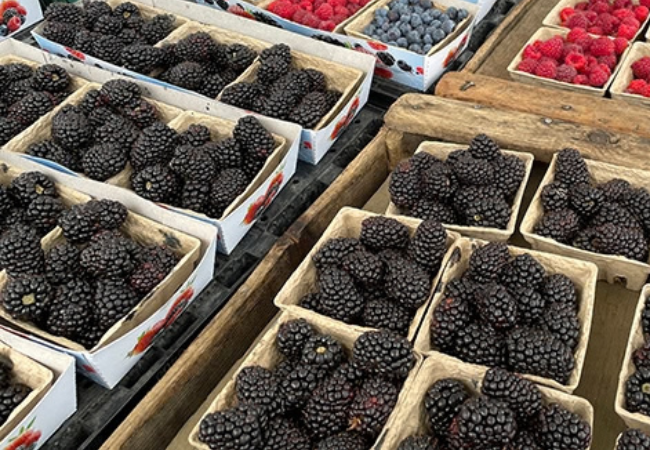
Just when apples, pears, winter squash, and pumpkins begin taking over the farmers market, there’s one last taste of summer tucked among the fall produce: fresh California-grown blackberries.
Along the Central Coast, our mild climate allows local growers to stretch blackberry season well beyond the height of summer. Some varieties naturally ripen later, while newer types can produce fruit on first-year canes, giving farmers an additional late crop. In fact, researchers have noted that primocane-fruiting blackberries can perform particularly well in the cooler conditions found in parts of coastal California.
At Monterey Bay Certified Farmers Markets, look for late-season blackberries from Cortez Farms, Borba Family Farms, and Prevedelli Farms. Depending on the farm and the week, you may find several different varieties—including Logan, Navaho, Osage, and Prime-Ark® Freedom.
And they don’t all taste alike.
Get to Know the Berries
Logan
Better known as the loganberry, this historic California berry has a wonderful local connection: it originated in Santa Cruz in the late 1800s. A blackberry-raspberry hybrid, Logan berries are usually elongated and deep red rather than glossy jet-black. They are juicy, aromatic, and noticeably tart, with some of the perfume and brightness of a raspberry. Traditionally an earlier-season berry, locally grown fruit may appear outside its usual window depending on farm location and production practices.
Navaho
Navaho is a true late-ripening blackberry with firm, medium-sized fruit and excellent flavor. The berries tend toward sweet and richly blackberry-like rather than sharply acidic, making them especially good for eating straight from the basket. Navaho was also one of the important early thornless, upright-growing blackberries developed by the University of Arkansas breeding program.
Osage
Developed with flavor very much in mind, Osage produces medium-sized, attractive berries noted for their excellent eating quality. They tend to have a pleasing balance of sweetness and berry flavor without excessive tartness. Osage is technically considered a mid-early cultivar, but growing conditions and farm management can influence when fruit reaches our local markets.
Prime-Ark® Freedom
This is where blackberry season gets especially interesting. Prime-Ark® Freedom was introduced in 2013 as the first thornless primocane-fruiting blackberry. Instead of producing fruit only on second-year canes, primocane varieties can also flower and fruit on new canes produced that same year. That can mean a second, later harvest extending into fall. The berries are very large, with good flavor and enough sweetness to make them particularly appealing for fresh eating.
That ability to produce a later crop is especially valuable in areas with mild summers and falls. University of Arkansas researchers specifically note that Prime-Ark varieties can produce particularly well in cooler areas such as coastal California.
A Berry Worth Tasting Before You Cook
When you encounter several blackberry varieties at the market, taste them side by side if you can. You may be surprised at the differences.
Some are intensely sweet. Others have more acidity or a deeper, almost wine-like berry flavor. Texture varies, too—from soft and exceedingly juicy to firm and substantial.
That makes fresh market berries quite different from the anonymous clamshell of “blackberries” we’re accustomed to seeing at the supermarket. Variety matters.
What to Do with Late-Season Blackberries
At this time of year, blackberries are particularly lovely paired with fall flavors.
Fold them into a rustic apple or pear crisp, spoon them over pancakes or French toast, or add a handful to a salad with toasted walnuts and a tangy cheese. Simmer them briefly into a compote for yogurt, cheesecake, pound cake, or ice cream. They’re wonderful baked into muffins and scones, and a blackberry sauce makes a beautiful accompaniment to roasted pork or duck.
For the simplest dessert, however, you hardly need a recipe: place ripe blackberries in a bowl, add a little sugar or honey if needed, and let them stand until their juices begin to run. Spoon them over softly whipped cream, vanilla ice cream, or a slice of simple cake.
And when the berries are extraordinarily good, don’t do anything at all.
Eat them out of hand.
Choosing and Storing Fresh Blackberries
Look for plump, deeply colored berries that appear fresh and dry, without crushed or leaking fruit at the bottom of the basket. Blackberries are delicate and highly perishable, so keep them refrigerated and plan to use them within a few days.
Wait to wash them until just before eating or cooking. Extra moisture encourages the fruit to deteriorate more quickly.
If you have more berries than you can use, freeze them. Arrange clean, dry berries in a single layer on a baking sheet, freeze until firm, then transfer them to a freezer container. They’ll be ready for smoothies, sauces, cobblers, and baking long after blackberry season has ended.
One Last Taste of Summer
There is something particularly delightful about finding locally grown blackberries in the market when the calendar already says fall.
They’re a reminder that California seasons rarely fit neatly into boxes—and that our farmers can offer extraordinary variety even as one growing season slips quietly into the next.
Look for late-season blackberries now from Cortez Farms, Borba Family Farms, and Prevedelli Farms at Monterey Bay Certified Farmers Markets. Like so many fleeting farmers market specialties, they’re worth enjoying while they last.