
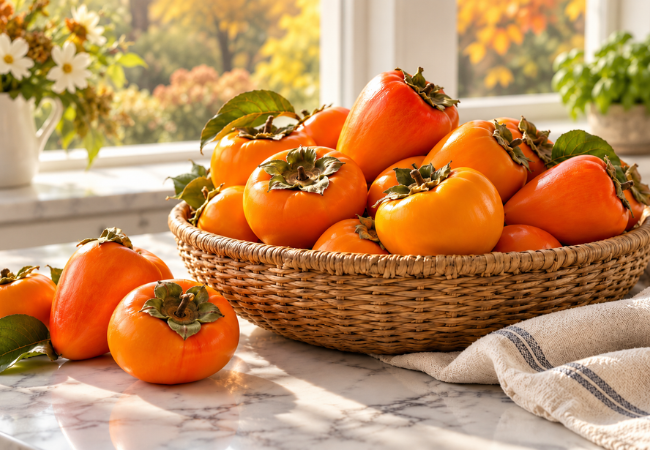
There is something unmistakably autumnal about persimmons. Their glowing orange color begins appearing at farmers markets just as the days grow shorter, bringing a welcome brightness to the late-fall table.
But persimmons can also be a little mysterious. Should they be crisp or soft? Why can one be eaten like an apple while another needs to become almost jelly-like before it tastes good? And what do you do with them once you get them home?
Fortunately, persimmons are much easier to understand once you know which kind you have.
Two Persimmons, Two Very Different Personalities
Most persimmons found at California farmers markets fall into two broad categories: non-astringent persimmons, such as Fuyu, and astringent varieties, such as Hachiya. The difference comes primarily from tannins—naturally occurring compounds responsible for that extraordinarily dry, puckering sensation you experience if you bite into an underripe Hachiya.
Both are wonderfully sweet when properly ripe, but their texture, flavor, and best uses are quite different.
Fuyu Persimmons: Crisp, Sweet & Easy to Love
If you’re new to persimmons, Fuyu is probably the easiest place to begin.
Fuyus are squat and rounded, somewhat like a flattened tomato, and are non-astringent. That means they can be eaten while still firm and crisp—no waiting required. Their texture can be similar to a crisp apple or pear, but their flavor is distinctly persimmon: mildly honeyed, delicately fruity, and gently autumnal.
As Fuyus sit, they gradually soften and become sweeter, so there really isn’t one “correct” stage at which to eat them. Some people love them crisp; others prefer them slightly yielding.
Look for: Deep orange fruit that feels heavy for its size, with smooth skin and a fresh-looking green calyx. Minor surface marks are generally nothing to worry about, but avoid badly bruised or damaged fruit.
Use them for: Eating out of hand, slicing into salads, adding to cheese or charcuterie boards, serving with yogurt, roasting, baking, or pairing with other fall fruits.
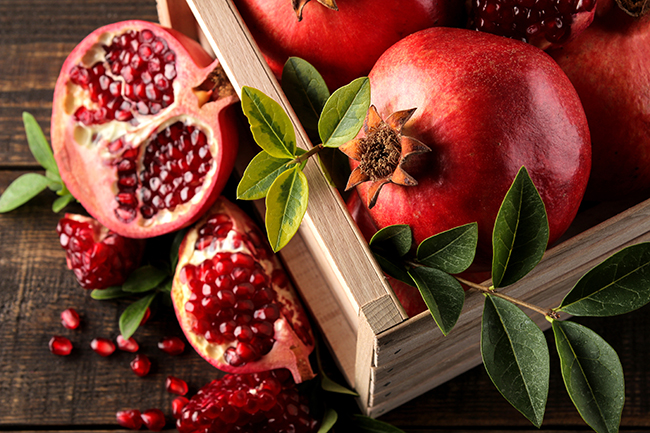
For salads, their firm texture is especially useful. Try sliced Fuyu with bitter greens, toasted walnuts or pecans, goat cheese, pomegranate seeds, and a bright vinaigrette.
Hachiya Persimmons: Worth the Wait
Hachiyas require patience—but reward it handsomely.
They are usually larger than Fuyus and have an elongated heart or acorn shape that tapers toward the bottom. Unlike Fuyus, Hachiyas should not be eaten while firm.
When underripe, their tannins create an intense mouth-drying sensation. But as the fruit ripens, that astringency disappears and the flesh transforms completely. A properly ripe Hachiya becomes extremely soft, translucent, and almost custard-like, with concentrated sweetness and a rich, honeyed flavor. UC guidance describes ripe Hachiyas as needing to reach that very soft, jelly-like stage before eating.
Look for: Fully colored orange to reddish-orange fruit without significant damage. It’s perfectly fine—and often preferable—to purchase Hachiyas while they’re still firm and allow them to finish ripening at home.
How do you know it’s ready? Forget the usual fruit test of “slightly yielding.” A ripe Hachiya should feel dramatically soft, almost like a small water balloon. If you’re wondering whether it is soft enough, it probably isn’t quite there yet.
Once ripe, cut it in half and scoop out the silky flesh with a spoon.
Use them for: Persimmon breads and cakes, puddings, muffins, sauces, smoothies, fruit purées, desserts, and traditional dried persimmons.
Ripe Hachiya pulp is especially useful for baking and can be frozen for later use.
How to Ripen Persimmons at Home
Firm Fuyus are ready to eat as soon as you bring them home, although you can leave them at room temperature if you prefer a softer texture.
Hachiyas need more patience. Leave firm fruit at room temperature and allow it to ripen naturally until completely soft. Fruit picked once it has developed good color will continue to soften after harvest.
Keep an eye on them—the change can seem slow at first, and then suddenly several are ripe at once.
Once your Hachiyas reach that luscious, jelly-like stage, either use them promptly or move them to the refrigerator.
Storing Persimmons
How you store persimmons depends on both the variety and its stage of ripeness.
Firm Fuyus can be kept briefly at room temperature or refrigerated to help preserve their crisp texture. Depending on ripeness, refrigerated Fuyus may keep from roughly a week to several weeks.
Ripe Hachiyas are much more delicate. Once fully soft, refrigerate them and use them fairly soon, or scoop out the pulp and freeze it for future baking.
If you suddenly find yourself with more ripe Hachiyas than you know what to do with, freezing the pulp is one of the easiest solutions. Portion it into containers in amounts you commonly use for recipes, label, and freeze.
And Then There Is Hoshigaki…
One of the most beautiful traditional ways to preserve Hachiya persimmons is hoshigaki, the Japanese technique of peeling whole firm persimmons, hanging them to dry, and gently tending them as they slowly transform.
Over several weeks, the fruit becomes soft and chewy inside, intensely sweet, and eventually develops a delicate coating of its own natural sugars. The finished persimmon has an almost date-like richness.
It is part preservation technique, part culinary tradition—and a lovely reminder that persimmons have been treasured in Asian cultures for centuries.
What About American Persimmons?
The persimmons we most commonly see at California farmers markets are Asian persimmons (Diospyros kaki), including Fuyu and Hachiya.
North America has its own native persimmon, Diospyros virginiana. Its fruit is generally much smaller and, like Hachiya, is strongly astringent until completely ripe. Once soft, however, it becomes exceptionally sweet and flavorful.
If you happen across native persimmons, remember the same rule: patience pays off.
Bringing Persimmons Into the Fall Kitchen
Persimmons pair beautifully with many of the flavors we naturally reach for this time of year: walnuts and pecans, pomegranate, apples and pears, citrus, warm spices, bitter greens, creamy cheeses, and honey.
A crisp Fuyu can go from the fruit bowl to a salad or cheese board in minutes. A meltingly ripe Hachiya can become breakfast, dessert, or the beginning of a batch of persimmon bread.
And that’s part of their charm. Two fruits that look remarkably similar offer completely different possibilities in the kitchen.
At the farmers market, look for beautiful fall persimmons at Schletewitz Family Farms, Stackhouse Orchards, Spade & Plow Organics, Prevedelli Farm, and Minazzoli Farms. Whether you prefer your persimmons crisp and refreshing or soft, sweet, and spoonable, they’re one of the fleeting pleasures of the season—and well worth bringing home.
Looking for inspiration? Explore our collection of Edible Paradise persimmon recipes for more delicious ways to enjoy the season.