
Once everyday kitchen staples, traditional animal fats are finding their way back into the skillet.
Open an old cookbook and you’ll find an ingredient that has largely disappeared from modern recipes: rendered fat.
Pie crust might call for lard. Potatoes were roasted in beef dripping. Chicken fat flavored everything from onions to dumplings. Bacon grease was carefully strained into a jar and saved rather than discarded.
For generations of cooks, this wasn’t a culinary trend. It was simply good kitchen economy.
Then vegetable shortening and inexpensive refined cooking oils arrived, dietary advice changed, and many traditional animal fats quietly disappeared from the American pantry.
Now they’re showing up again.
Tallow and lard have become increasingly popular with home cooks, chefs, whole-animal butchers, and small farms. Some of the renewed interest is tied to particular diets, but there’s another, much more interesting reason for cooks: these fats have distinct flavors and cooking qualities that vegetable oil simply doesn’t duplicate.
And at our local farmers markets, they can also be part of a larger conversation about knowing where our food comes from and making thoughtful use of the whole animal.
First Things First: What Are They?
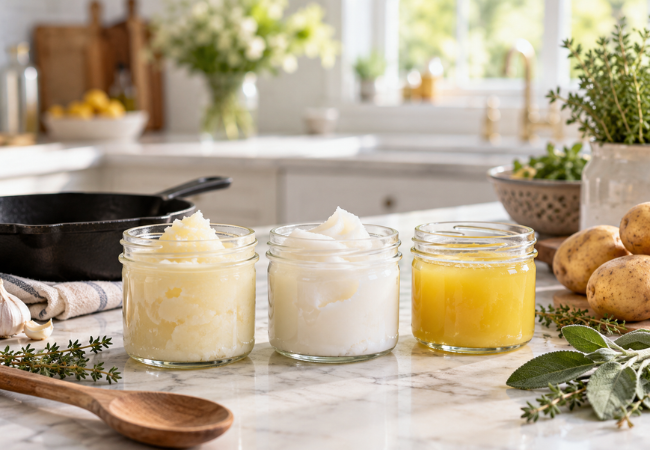
Tallow is rendered beef fat. Beef fat is slowly heated until the liquid fat separates from the connective tissue and other solids, then strained and cooled. Properly rendered tallow becomes firm at room temperature and is generally pale cream to white.
You may also encounter the term ‘beef dripping’, particularly in British cooking. The terminology varies somewhat, but both refer to rendered beef fat used for cooking. Traditionally, especially prized tallow is made from the hard fat surrounding the kidneys, known as suet.
Lard is rendered pork fat. Like tallow, its character depends on which fat is used and how it is rendered.
The most prized lard for baking is generally leaf lard, made from the soft visceral fat found around the kidneys and loin. It has a relatively mild flavor and an exceptionally tender texture, which is why generations of bakers relied on it for biscuits and pastry.
Regular rendered pork fat may have more pronounced pork flavor — which can be exactly what you want for savory cooking.
And then there is schmaltz, traditionally rendered chicken or goose fat. Golden, deeply savory chicken fat deserves a place in this conversation, too. A spoonful can transform roasted potatoes, sautéed onions, vegetables, rice, or a pot of beans.
Why Cooks Love Them
There’s a temptation to discuss cooking fats entirely in terms of which one is supposedly “best.”
But from a cook’s perspective, that misses the fun.
Olive oil, butter, lard, tallow, avocado oil, chicken fat, and other cooking fats aren’t necessarily interchangeable. Each brings different flavor and texture to food.
Tallow has a rich, savory beef character that pairs especially well with potatoes and root vegetables. It also performs well for high-temperature cooking; references commonly place its smoke point around 400°F, although exact smoke points vary depending on how a fat has been rendered and refined.
Lard is softer and generally more neutral, particularly leaf lard. It has long been valued for producing remarkably tender baked goods and beautifully crisp foods.
Chicken fat is somewhere else entirely — silky, savory, and deeply flavorful.
The question isn’t necessarily, Which fat should replace everything else in my kitchen?
A better question might be: Which fat will make this particular dish delicious?
Where Tallow Really Shines
If you’ve never cooked with beef tallow, start with potatoes.
Toss cut potatoes with a modest amount of melted tallow, salt them generously, and roast until crisp outside and creamy inside. There’s a reason British cooks have roasted potatoes in beef dripping for generations.
Tallow is also wonderful for roasting carrots, parsnips, onions, winter squash, and other vegetables destined for a deeply browned exterior.
Use it to sear beef, fry hash potatoes, grease a cast-iron pan, or sauté mushrooms and onions destined for a steak.
A small spoonful stirred into a beef stew or used to begin a pan sauce can reinforce the flavor already in the dish without adding another competing flavor.
Where Lard Really Shines
Lard has an entirely different résumé.
It makes famously flaky pie dough and exceptionally tender biscuits. It is traditional in tortillas and tamales. It can produce beautifully crisp fried foods and is wonderful for frying potatoes or cooking eggs.
Try using a spoonful to sauté cabbage, greens, beans, or onions.
And don’t overlook lard in savory pastry. Empanadas, hand pies, galettes, biscuits, crackers, and potpie crusts can all benefit from its texture.
Leaf lard is especially suited to baking because its flavor is generally much less assertive than fat rendered from other parts of the pig.
And That Jar of Chicken Fat?
Save it.
Chicken fat may be one of the most underappreciated ingredients in the modern kitchen.
Use schmaltz to sauté onions, roast potatoes, crisp leftover rice, cook mushrooms, or add richness to beans and grains. Try brushing a little over vegetables before roasting them.
Even a tablespoon can add an extraordinary amount of savory flavor.
This is one of those ingredients where “waste not, want not” turns out to be excellent culinary advice.
Rendering: An Old Kitchen Skill Worth Remembering
Rendering sounds technical, but the principle is simple: fat is heated gently so that the pure fat separates from water, connective tissue, and other solids.
Low, patient heat is the secret.
The rendered liquid is then strained while warm and allowed to cool. Beef tallow becomes quite firm; lard and poultry fats generally remain softer.
If you’re rendering fat yourself, start with exceptionally fresh fat from a source you trust, use clean equipment, strain it carefully, and refrigerate the finished product. If there is any question about freshness or proper handling, discard it.
You can also skip the rendering entirely and purchase prepared fats from a farmer, butcher, or producer.
A Farmers Market Ingredient
One particularly nice thing about rediscovering these traditional fats is that they invite us to think differently about the animals that provide our food.
Using the fat as well as the familiar cuts of meat is part of the older practice of whole-animal cooking — finding value and purpose in parts that might otherwise be overlooked.
At Monterey Bay Certified Farmers Markets, ask producers about the fats and traditional animal products they may have available. Schoch Family Farmstead raises beef, while Fogline Farms produces poultry and pork. Kitchen Table Cultures also offers traditional foods such as bone broth that fit beautifully into this style of whole-food, nose-to-tail cooking.
Availability can vary, so this is one of those wonderful farmers market conversations to have directly with the producer.
Ask where the fat comes from. Ask how it was rendered. Ask how they like to cook with it.
Farmers are often the source of the best kitchen wisdom.
But Is Animal Fat “Healthy” Again?
This is where the modern conversation becomes complicated.
The renewed popularity of tallow and lard has been accompanied by plenty of sweeping claims online — including the idea that animal fats have somehow been completely vindicated while vegetable oils have been proven harmful.
Nutrition science isn’t quite that simple.
Tallow and lard contain saturated fat, although their fatty-acid profiles differ, and current cardiovascular guidance still recommends replacing some sources of saturated fat with foods containing unsaturated fats. The American Heart Association’s updated 2026 dietary guidance continues to emphasize unsaturated fats as part of a heart-healthy dietary pattern.
That doesn’t mean a jar of locally rendered lard needs to be banished from the kitchen.
It simply means we don’t have to turn one delicious ingredient into a miracle food — or another into a villain.
Olive oil can stay.
So can butter.
And there may be room beside them for a jar of tallow, lard, or chicken fat.
The Real Wisdom May Be in the Variety
Perhaps what’s worth rediscovering isn’t just animal fat.
It’s the older idea that a good cook keeps several fats for several purposes.
Olive oil for vinaigrettes and vegetables.
Butter for flavor and baking.
Lard for flaky pastry.
Tallow for beautifully browned potatoes.
Chicken fat for onions and savory dishes.
Rather than asking one bottle of cooking oil to do absolutely everything, our grandparents understood something we may finally be remembering:
Fat isn’t merely something that keeps food from sticking to the pan. It’s an ingredient — and sometimes, it’s where much of the flavor begins.
TRY THESE RECIPES: Crispy English-Style Roast Potatoes with Beef Tallow, Tallow-Roasted Carrots, Onions, and Parsnips with Sage